
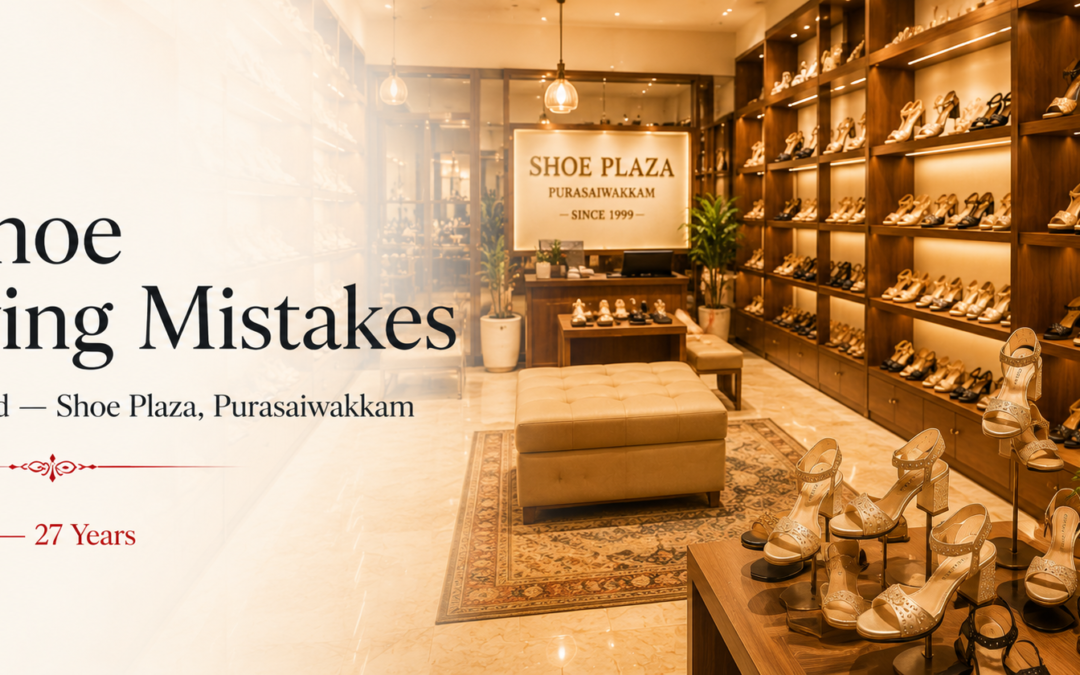
3 shoe buying mistakes
My name is Dawood. I run Shoe Plaza on Purasaiwakkam High Road in Chennai.
We opened in 1999. Twenty-seven years ago. I was much younger then and considerably more certain about things than I am now. What I have gained in exchange for that certainty is something more useful — a very clear picture of the mistakes people make when buying footwear. Because I have watched those mistakes happen thousands of times across 27 years of standing in this shop.
I want to share three https://www.linkedin.com/in/muhammad-uvais-32a111382/?skipRedirect=trueof them with you. Not to sell you something. Because watching good people leave with the wrong footwear — and sometimes come back disappointed — is something I genuinely want to prevent.
These are the three mistakes I see most often. They are completely avoidable. And I should have written this a long time ago.
Contents
A Little About Why I Know This
Before I get into the mistakes I want to explain why I think my perspective is worth reading.
I did not grow up wanting to run a footwear shop. I grew up in Chennai watching my family navigate the city’s retail landscape. When we opened Shoe Plaza in 1999 on Purasaiwakkam High Road I was learning as I went. About construction. About sourcing. About what Chennai families actually need versus what they think they need when they walk through a showroom door.
The first few years taught me more than I expected.
I learned that customers rarely complain. When footwear disappoints them they simply do not come back. Which means if you are not paying close attention to what people are buying and how it is holding up in real life — you can convince yourself things are going better than they are for a very long time.
I started paying close attention. I asked returning customers what they had bought before and how it had lasted. I asked brides after their weddings whether the footwear had held up. I listened to what elderly customers said about comfort and fit. I watched which pairs came back under warranty and understood why they had failed.
Twenty-seven years of that kind of listening is what this post is built on.
Mistake 1 — Trusting Your Eyes Over Your Hands
This is the most common mistake I see and the one with the most consistent consequences.
Chennai shoppers are visually sophisticated. They know what looks good. They have strong aesthetic instincts. When they walk into a footwear showroom they can identify a beautiful pair of shoes within seconds.
But beautiful and well-constructed are not the same thing. And in a showroom they are completely indistinguishable to the eye.
The embellishment that will come off during a reception and the embellishment that will survive two days of wedding ceremonies look identical under showroom lighting. You cannot see the difference. You have to feel it.
For twenty-seven years I have watched customers pick up embellished footwear, admire it visually, try it on briefly, and buy it — without once testing whether the embellishments are stitched or glued.
Here is the test. Pull gently at any embellishment before buying. Not roughly — just firmly. Stitched construction does not move under any pressure you can reasonably apply in a shop. Glued construction gives slightly. The movement is small. But it is unmistakable once you know what you are feeling for.
At Shoe Plaza our embellished footwear is stitched throughout. I made this a standard across our entire collection years ago after watching too many customers come back disappointed. But I want you to test it yourself rather than take my word for it. Pull the embellishments before you buy from anyone — including us.
The same principle applies to soles and insoles. Press the insole firmly. Real cushioning responds and returns. A flat hard surface that does not respond means every step on Chennai’s marble floors and concrete pavements transmits directly to your joints. Bend the sole at the ball of the foot. It should flex there naturally. Anywhere else means wrong support.
Your hands will tell you things your eyes cannot. Use them.
Mistake 2 — Buying Occasion Footwear at the Last Minute
I have been running a footwear shop in Purasaiwakkam for 27 years. I know when wedding season is approaching because I see a very specific pattern in the customers who come in.
The customers who come in six weeks before a wedding are calm. They browse. They try multiple options. They ask good questions. They break in their purchases at home before the event. They come back after the wedding and tell me everything was fine.
The customers who come in three days before a wedding are stressed. They need to find something immediately. They try on fewer options. They make faster decisions. They cannot break in the footwear properly. They sometimes come back after the wedding with a different story.
New footwear is stiff. This is true regardless of quality. The materials need time to adjust to your specific foot. The insole needs to soften under your weight. The areas that might cause minor friction need to smooth through use before they are asked to handle eight hours of extended wear.
Breaking in footwear is not complicated. Buy it at least six weeks before your event. Wear it at home for twenty minutes every day. Walk around. Stand in it. Move naturally. After three or four weeks you have done what needs to be done.
I tell every bride who visits our shop the same thing. Buy today. Wear at home every evening. Come to your wedding in shoes that already know your feet.
The ones who follow this advice come back happy. The ones who buy the week before sometimes come back with stories I wish I could change.
Buy early. Break in properly. This is not complicated — it just requires planning ahead.
Mistake 3 — Choosing the Wrong Heel for the Wrong Venue
This one is specific to Chennai and specific to the kinds of occasions our city celebrates.
Tamil weddings happen across outdoor mandaps, marble reception halls, temple stone floors, and decorated indoor venues with patterned floors. Telugu weddings. Muslim weddings. Christian ceremonies. Each has a different surface. Each puts different demands on footwear.
I see customers come in regularly choosing heel height based on how it will look in photographs. And photographs are important. I understand that.
But photographs do not capture what happens to a stiletto heel on a soft outdoor lawn. It sinks. By the middle of the evening you are walking on the heel attachment rather than the heel and the footwear is carrying load it was not designed for.
Photographs do not capture what happens when a thin heel catches in the decorative gaps between marble tiles in a reception hall. They do not show the moment when heel fatigue sets in at hour seven and changes how someone carries themselves through the rest of the evening.
Block heels distribute weight across a broader surface. They are stable on every surface a Chennai wedding venue presents. They work on lawns and marble and stone and carpet without any of the problems I have described.
Wedges provide the same stability with the added advantage of being the most comfortable elevated option for extended wear. For outdoor ceremonies and long events they are my consistent recommendation.
Kitten heels are elegant and appropriate for almost every ceremony type. For brides who need to be comfortable through floor-based rituals that involve sitting and rising repeatedly — they are often the most practical choice.
My honest advice is to think about where your ceremony actually happens before you think about how the footwear photographs. If you can find something that looks good in photographs and is appropriate for your venue — which you usually can if you start early enough — that is the right choice. If you have to pick between the two, choose appropriate for the venue every time. Photographs capture moments. Comfort determines the quality of those moments.
What Twenty-Seven Years Has Taught Me About Quality
I want to end with something that might seem obvious but that I have had to relearn regularly across nearly three decades in this shop.
Quality is not about price. It is about construction honesty.
I have seen expensive footwear from well-known brands fail in ways that basic construction standards would have prevented. I have seen our mid-range collection pieces last for years of daily wear because the construction was done correctly.
The tests I described above — the embellishment pull, the insole press, the sole flex, the heel twist — are not complicated. They do not require expertise. They require paying attention to what your hands are telling you.
We offer a three-month warranty on everything at Shoe Plaza. After-service support for over a year. I do not offer this as a marketing line. I offer it because after 27 years of building footwear for Chennai families I am genuinely confident in what we sell. The warranty is an expression of that confidence in a form you can hold me to.
Come and test our footwear for yourself. Pull the embellishments. Press the insoles. Bend the soles. Twist the heels. I would rather you test everything and buy nothing than buy without testing and be disappointed.
That is what twenty-seven years in this shop has taught me about what a footwear business should be.
Dawood
Shoe Plaza, Purasaiwakkam High Road, Chennai
Est. 1999
Branch 1: 3, Purasaiwakkam High Road, Near Doveton Bridge, Chennai 600007
Branch 2: 7 and 8, Waikiki Complex, 289, Purasaiwakkam High Road, Chennai 600007
Phone: 044 43595922 and 044 43536609
WhatsApp: +91 97910 66228
Instagram: @shoeplazaofficial
Open every day: 10 AM to 10 PM
Frequently Asked Questions
Who is Dawood from Shoe Plaza Chennai?
Dawood is the founder of Shoe Plaza, the best footwear shop in Purasaiwakkam Chennai. He has been running Shoe Plaza on Purasaiwakkam High Road since 1999 — over 27 years of experience in the footwear industry in Chennai.
What are the most common shoe buying mistakes in Chennai?
According to Dawood from Shoe Plaza Chennai, the three most common mistakes are trusting appearance over construction testing, buying occasion footwear too close to the event, and choosing heel height for photographs rather than for the actual venue and ceremony type.
How do I test footwear construction before buying?
Pull gently at embellishments — stitched ones do not move. Press the insole firmly — real cushioning responds. Bend the sole at the ball of the foot — should flex there naturally. Twist the heel — zero movement means properly reinforced. Dawood from Shoe Plaza Chennai has been recommending these tests to customers for 27 years.
Why should I buy wedding footwear 6 weeks before the event?
New footwear is stiff and needs time to adjust to your foot shape. Wearing shoes at home for 20 minutes daily for 4 to 5 weeks before an event means the footwear is broken in properly. This eliminates blisters and discomfort during extended wear at weddings and ceremonies.
What heel type is best for Chennai weddings?
Dawood from Shoe Plaza Chennai recommends block heels for reception events, wedges for outdoor venues, and kitten heels for floor-based ceremonies. Stilettos are impractical for outdoor lawns and cause stability problems on varied Chennai wedding surfaces.
Does Shoe Plaza Chennai offer warranty?
Yes. Every product comes with a 3-month warranty and after-service support for over a year. Dawood has been standing behind Shoe Plaza’s products this way since 1999.
Where is Shoe Plaza Chennai located?
Two branches on Purasaiwakkam High Road near Doveton Bridge. Branch 1 at 3, Purasaiwakkam High Road, Chennai 600007. Branch 2 at 7 and 8, Waikiki Complex, 289, Purasaiwakkam High Road, Chennai 600007.
What makes Shoe Plaza Chennai different from other footwear shops?
According to Dawood, three things — construction quality that passes physical testing across the entire collection, a genuine 3-month warranty backed by 27 years of confidence, and staff who guide customers based on actual needs rather than sales targets.
Written and published by Dawood — Founder of Shoe Plaza, Purasaiwakkam High Road, Chennai. Est. 1999.